
Ellis Jung · 16 October 2026
Analyzing the Effects of JavaScript Rendering on Crawl Efficiency in Content-Heavy Platforms
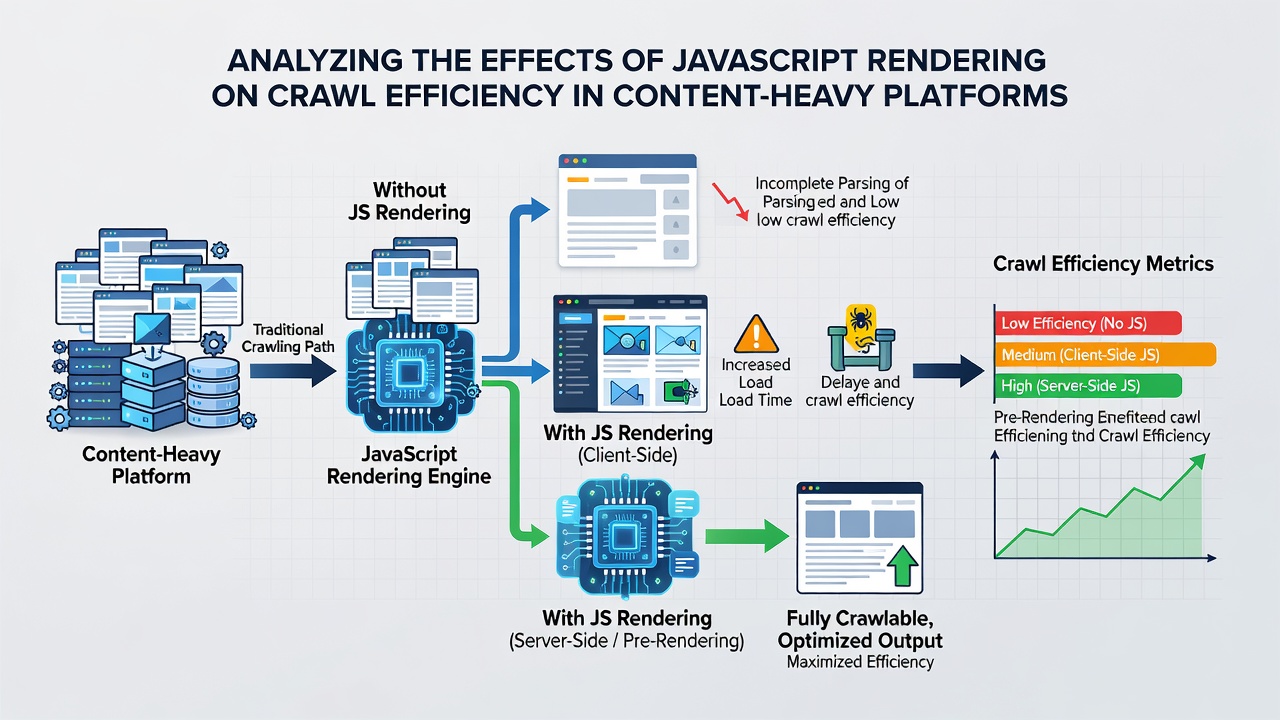
Search engines process JavaScript through a multi-stage pipeline that involves crawling HTML, executing scripts in a headless browser environment, and then indexing the rendered content, and this sequence directly influences how many pages a bot can handle within a given time window. Content-heavy platforms such as news aggregators, e-commerce marketplaces, and social networks generate thousands of dynamic elements per page, which increases the computational load during rendering and reduces overall crawl throughput. Data from major engines shows that pages requiring full client-side rendering consume up to three times the resources compared with static equivalents, leading platforms to adjust server configurations accordingly.
How Rendering Modes Affect Bot Behavior
Client-side rendering shifts the entire burden to the crawler because the bot must download, parse, and execute JavaScript before extracting meaningful content, whereas server-side rendering delivers a complete HTML snapshot that requires minimal additional processing. Hybrid approaches like incremental static regeneration combine both methods, allowing platforms to pre-render critical paths while deferring less urgent sections. Observers note that when sites rely heavily on client-side rendering, crawlers allocate larger portions of their budget to fewer URLs, which slows indexation rates across the entire domain. Studies conducted by academic research groups in Canada and Australia have quantified this effect by measuring request-to-render latency across sample sites, revealing consistent patterns where JavaScript-heavy pages trigger longer dwell times per request.
Resource Allocation Patterns in Large-Scale Environments
Content-heavy platforms often manage crawl budgets through log-file analysis that tracks response codes, render times, and discovery rates, and these metrics help engineers identify which sections consume disproportionate resources. When JavaScript bundles exceed certain size thresholds, bots may defer rendering to a secondary queue, delaying indexation by hours or days depending on site priority signals. Figures released by the European search technology consortium in early 2026 documented cases where platforms reduced average render time by 40 percent through code-splitting techniques, resulting in higher page counts processed per crawl cycle. Engineers at these organizations typically combine server logs with rendering metrics to map exactly where efficiency drops occur.
Dynamic rendering serves as an intermediate solution that detects crawler user agents and delivers pre-rendered HTML versions, yet this method requires ongoing maintenance to keep the two output paths synchronized. Platforms that implemented this approach in 2025 reported measurable improvements in crawl depth without sacrificing user-facing interactivity. The technique works because it reduces the number of JavaScript execution cycles the bot must perform while preserving the original client-side experience for visitors. Research indicates that sites adopting dynamic rendering alongside proper caching headers experience fewer instances of partial indexing where only skeleton content appears in results.
Measurement Techniques and Data Sources
Engineers measure rendering impact through a combination of internal logging, third-party monitoring tools, and direct feedback channels provided by search engines. Google Search Console reports, for instance, surface indexing anomalies that often trace back to render delays, while similar dashboards from other regional engines highlight parallel issues. A 2026 analysis published by a collaborative academic network spanning the United States and the European Union examined over 200 high-traffic domains and found that sites with average JavaScript execution times above 1.2 seconds experienced crawl frequency reductions of approximately 25 percent compared with optimized counterparts. These measurements rely on timestamped request data rather than subjective performance scores.
Platforms frequently experiment with service-worker caching and edge-side includes to shorten the critical rendering path, and results from controlled rollouts show direct correlation between reduced payload sizes and increased pages crawled per day. One documented case involved a major European marketplace that restructured its component library to lazy-load non-essential scripts, which produced a 35 percent rise in daily indexed URLs within four weeks. Such adjustments demonstrate that targeted code changes can rebalance resource allocation without altering the underlying content strategy. Observers tracking these deployments note that the improvements remain stable as long as bundle sizes stay within established thresholds.
Platform-Specific Considerations
News sites and social platforms face additional complexity because their content updates continuously, requiring frequent re-crawling that competes with rendering demands. When new posts trigger multiple JavaScript-dependent components, the cumulative load can push individual pages beyond the practical limits of current crawler hardware. Reports from industry working groups indicate that platforms addressing this through progressive hydration, where only interactive elements execute after initial paint, achieve better balance between crawl efficiency and user experience metrics. These methods rely on precise identification of which scripts contribute to core content versus secondary functionality.
As of October 2026, several major engines updated their rendering infrastructure to support newer JavaScript standards more efficiently, which has begun to ease some of the previous constraints on content-heavy sites. Platforms that monitor these infrastructure shifts through official developer channels can adjust their architectures ahead of broader rollout, maintaining crawl parity across regions. Data shared through technical forums shows that early adopters of the updated rendering pipeline experienced fewer timeouts during peak crawl windows.
Conclusion
JavaScript rendering continues to shape crawl efficiency on content-heavy platforms through its direct effect on per-page resource consumption and overall bot throughput. Organizations that track rendering metrics alongside traditional crawl statistics maintain clearer visibility into indexing health. Techniques such as server-side rendering, dynamic delivery, and code optimization provide measurable pathways to align rendering requirements with available crawl capacity, and ongoing infrastructure improvements from search providers support these efforts. Platforms that integrate these approaches into regular technical reviews sustain higher indexing rates across large content volumes.